Featured post

What does Paradise cost?

"I'm leaving New Zealand to travel, see and hunt the world" It’s hard to explain it to people. W hen others tried to expl...

Tuesday, 19 January 2016

Day 2 - 7 Species in 3 days - Shooting the Scottish Highland's

After a cracking day at Red Castle, we started Day 2 with something very traditional. Alex took me Wild Fowling, in an attempt to get me my first Wigeon, and what ever else the Firth might produce. With so many species living and roosting on it, you just never know what may fly your way. The tides on the Moray Firth weren't perfect, with the rocks that were to offer us great cover, and get us close to the flight line still well under water, but with the birds flying at first light, you cant afford to wait for the tide either. We therefore perched ourselves as close to the water, and the deeper channel as we could, and waited for the birds to fly on dawn. Fly they did, and we saw good numbers of both Wigeon and Mallard, but they were just out of range, but I still got to see my first Wigeon! All in all, it was a morning well spent on the Firth.


We headed home for breakfast, then Alex told to me to change out of the welly's and into hiking boots, as we were off to do some miles in the hills looking for Pheasant's and, possibly even get a shot at my first Partridge.

Arriving at Cawdor, We met up with the rest of the crew, both of the 2 and 4 legged variety. We were hunting over pointers, and they looked as excited as I was. We worked our way to the first section of real cover, each taking a line. I was beside Phil on the far right, and enjoyed watching his dog work the scent. I enjoyed it even more when I saw him go into Point. Suddenly, a Cock Pheasant exploded from in front of the pointer, and Phil took in cleanly. On the Shot, a Cock flushed at long range in front of me. I still felt I had a shot, and took it. Down the bird came, but I could tell it wasn't taken cleanly. The pointer, turned, and on command, raced up after my bird.  During the retrieve, yet another pheasant flushed on our side, from the same cover. This time a Hen. Phil took it cleanly on the first shot, and we waited for the pointer to return to retrieve it. I watched the dog running all over the place, and eventually, in a totally different location to where I thought my bird was, or would be, he got really excited. The dog found it, about 500 meters from where I saw it go down, and promptly returned it to Phil's hand. It was the best unsighted retrieve I have ever seen.

We continued on through the fields, and could tell the dogs were picking up scent. We arrived at a good deal of low cover, and Phil told us he reckoned the pointers were on to Partridge. They told me there wasn't a huge amount of Partridge where we were, as they were wild birds that had fled from various hunting estates in the area. We worked cover to cover, when, with an flurry of wing beats, the covey flushed - but well ahead of us, and the dogs. We kept working the cover, and another covey flushed in front. I was far to slow, and missed with both barrels behind, but the others pulled down one on a fine crossing shot, and we had our first Partridge. Seconds later, another covey flushed. This time they were flushing left to right. I was still in the wood, and had trees in every direction, but I had a clear wedge of about 40 degrees to swing through. I watched the covey come from my left, being chased by shots, and as they passed through my shooting window, up came the side by side, and down went a Red Legged Partridge! While we do have Red Legged Partridge in New Zealand, they are not found in the wild, and are only hunted on private hunting estates, so to not only see one, but bag one in the Scottish Highlands was amazing.

We headed back to the vehicle's, and took a short drive up a winding, climbing road, through forest and heather, where I was introduced to some of the most beautiful country I have ever hunted pheasants in - the Drynachan Valley. With rolling hill country, over looking the famed Findhorn river, it was a great spot to have lunch as well, and I enjoyed a traditional Scotch Egg Pie and a brew for lunch, swapping stories. Just sitting their in the sun, having lunch with new friends in the highlands makes you realise just what hunting is about.

The rest of the afternoon was spent on a very memorable walked up day on the Pheasants. The dogs were great, pointing and flushing a good number of birds, and with the rolling hills, and variety of cover, it seemed every bird offered something different. Considering it was late December, the fact the I got sunburned tells you just how off kilter the weather was at this time of year, as we should have been walking through snow! I had a lucky line once again, and managed a left and a right on a Cock and a Hen, and picked up another Cock towards the end, with everyone else either also bagging a bird, or having an opportunity to do so.  I'd fired 8 shots for 4 Pheasants and a Partridge - not a bad afternoon! Now it was off home, to swap the boots for welly's, pick up Don, and head to a flooded paddock, and see what would come in on dark.

Meeting up with the other two lads who had invited us down, we made our way through the sodden paddocks, where we found a large body of flood water. There were no birds on it, but there was a mob of Pink Foot Geese on the next paddock over. Leading up to dark, we saw several mobs of
geese wiffle down and join their friends, then one mob came a little close to us, and Alex dropped one out of the mob. I was on the board next, with a left and a right on mallards. It was getting quite dark at this point, when I heard a sound ill never forget - Wigeon! I didn't even have time to lift my gun, but Alex certainly did, and he bagged a fine Wigeon drake. It was one hell of a shot! We could hear Wigeon, but as is their custom, they were coming through right on the very end of twilight. There were ducks all over the place, either coming to the flood water, or flying over us, when I caught a glimpse of a duck in the last clear and light piece of sky I had to backdrop a bird with. I took the shot, and heard it hit the ground. It wasn't till good ol' Don retrieved it, that I found out I'd just bagged my very first Wigeon, and it was a drake! On that note, we packed up and headed out with our bag - one very happy Kiwi hunter, and what a day! Alex really pulled out the stops and did all he could to help me bag a variety of species, and a big thank you to Andrew for allowing us down to shoot his land, where I got my Wigeon. We had done everything on day 2, I couldn't really imagine how we could top it. Boy was I wrong. Day 3 added another species to my list, and it was the one bird I'd really hoped to get....


Tuesday, 5 January 2016

Beautifully Ordinary.

I came across an old photo the other day.

It was just a picture of a battered, ordinary looking Browning A5, with some very ordinary decoys, and an ordinary pair of ducks.

But the story of the gun itself and how I came to have it, and indeed the story of its first owner is not so ordinary.

My grandfather moved to Mainland New Zealand from the Chatham Island's following World War Two. "The Chatham's" was, and still is one of the most isolated locations in all of New Zealand, separated from the mainland by 700 kilometres of some of the roughest seas in the world - the "roaring forties". On his arrival from isolation, Laurie was naive to a lot of things. When given his first ice cream, not knowing what it was, he bit into it like a piece of fruit, and was so surprised, he dropped it!. This, if anything showed just how much there was to learn on the mainland. Having lived on an island where wild cattle, Fowl and Boar were in constant need for management or to be put in the oven, where hunting and gathering weren't just sport, but for survival, one thing he did not need to learn, was how to shoot.

On arrival to the mainland, he took up clay target shooting, both as a sport, but also to win useful prizes to support his family. He went on to compete in the 1954 New Zealand Down The Line, Single Rise, National Championship. In the shoot off to see who would compete in the final, with his last cartridge of the day, he won the shoot off, but his trusty browning A5 broke down. A young gun smith called Ian Ballinger, who was present, told my grand father, "Laurie, give that gun to me and it'll be right as rain for the final tomorrow" - or words to that effect.

Bright and early, my grand father turned up to shoot for the title, and all ready there waiting, A5 in hand, was Mr I. Ballinger. My grandfather won the title, and sold the A5 when the family fell on hard times, and there you think, the story ends.
While at University, and following in my family's hunting footsteps, I ended up working part time as a gun salesman for one of New Zealand's longest running gun shops - none other than Ballingers of Christchurch, founded by I. Ballinger. While there I ran into the original man whom my grandfather had sold the A5 to, also a friend of my fathers. He recognised my last name, and introduced himself. I asked him "what ever happened to that A5?"?

 A few owners and a lot of phone calls later, I tracked the new owner down. He said he couldn't sell me the gun...but he did give it to me. I was very proud grand son when I told Laurie, his old Browning was back in Lanauze hand's once more.

Not long after this, I carried that A5 into my grand fathers funeral and placed it on his coffin, when his time with us was at an end. Afterwards,  I took out the A5 for the 2008 Duck opening weekend, and created my own history with the famed gun, making me the 3rd Lanauze (there may have been more!), after my father and grandfather, to have hunted with this workhorse. I spent opening weekend hunting with my brother in law - Rob, in our Maimai (hide) right next to my fathers on a family friends farm that we have shot for over two decades, I shot my first Duck and my first Goose on this farm. The fist day of the season was clear and calm - not perfect weather for open water mallards, but Rob and I had a good spread out, and called hard. We ended up with a good bag of Mallard and Paradise duck. Not a bad performance by Rob and I, and the over fifty year old Browning A5!

The following day was much better, with wind and rain, which made the Mallards trade more. We got a great mixed bag that second day, with 20 Mallard, some more Parries, and a brace of hard won Canada Goose.

It was eventually time to retire the old girl, so I took the A5, dads old cork decoys that I "touched up" and the V decoy spread he used so well.

This was the last pair of mallards it shot.

After serving three generations of my family, along with others in it's travels, it has been retired from service.

My father and grandfather are both shooting the big duck pond in the sky now, but when it's my time, I'll try to slip the A5 in past security and join them.

Beautifully Ordinary


Sunday, 3 January 2016

Day 1 - 7 Species in 3 Days - Shooting the Scottish Highland's

Alex had seen one of my posts on a UK shooting forum, and having enjoyed hunting, shooting and fishing around the world himself, and knowing how difficult it can be, he was quick to email me and invite me up to the Scottish Highland's between Christmas and New Year's. The trip got off to a horrid start, with the bus from London to Inverness running 2 hours behind schedule, not great when I was meant to get in to Inverness at 11pm. To make matters worse, the bus left us at a layby at midnight, and told us taxis would be taking us the last 2 hours! Eventually a 5 seat taxi turned up to transport 11 of us. After another delay, a van finally arrived and we were off.
No sooner had we left Perth, than our taxi driver and an oncoming car drove right into a herd of cattle that had escaped and were on the open road. Both cars were written off, and several cows killed. It was horrific, but the fact that there were no human fatalities was a miracle.
After waiting two more hours, I finally got to Inverness where I was met by Alex and his lovely wife Elsa just before 4am. We got two hours sleep, before we were off to hunt Red Castle, where we all hoped, my luck would improve!

Red Castle, was until recently, one of the oldest inhabited houses in Scotland, with its last residents being recovering RAF pilots during and after the Second World War. The original castle here was first constructed in 1179 and was known as Edirdovar. The present building is dated at 1641 - making it 200 years older than my home country of New Zealand!

Day 1 at Red Castle was very warm, as had been the preceding weeks, and Alex and the rest of the crew explained to me that that was bad for us. The warmer than usual weather meant the pheasants were likely to roam, rather than continue to feed at the feeders which meant  numbers would be down as they left our hunting area in search of naturally available food. That being said, many of the crew turned up, with us split into two teams. One team would beat and drive the birds to the other team who would be standing guns, then after each drive, we would swap around. This was to be my first driven Pheasant shoot, anywhere in the world.

My team and I started off beating, and I flushed 3 cock birds as we walked the hill country. Those, along with other birds flushed gave the standing guns plenty to shoot at, and we had our first pheasant in the bag!

The second drive gave me my first chance as a standing gun. A cock bird came through, but it was flying behind trees and shrubs, which deflected the pattern - another way of saying I missed him! I was lucky enough to have a Roe Doe walk right up to me before taking my shot, she stood there for 10 seconds, 15 meters away, then wondered off into the forest - Awesome!
Throughout the day, we saw a number of birds, and one of the lads even managed a couple of Woodcock! I was happy for him, but very jealous at the same time, having missed a tough shot on one myself. It was one of the birds I was hoping to bag while away from New Zealand. The Woodcock are migratory birds that come over from Finland and Russia to winter in the UK. They are tough to hit, and taste delicious...or so I've been told!
On the last drive of the day, I had two cock birds flush towards me, about 20 seconds apart. I dropped them both, giving me my first ever driven pheasants. It was nice to be shooting them in the head and chest, rather than as they are quartering away, which is how they normally present themselves over dogs, They were moving a bit faster than I'm used to, flying up high, having the wind behind them. They were great sporting birds and I was chuffed to have been given the opportunity to bag them.


After we had finished the drives for the day, where I had seen a good number of Pheasant, Woodcock and Roe Deer, a few of us decided to have a crack at some Greylag Geese that were feeding in a nearby field. 5 of us were to pick a spot on a fence line, while another one of the lads flushed the geese up. It was only a small mob of about 20, so this seemed to be a logical way of targeting them, rather than trying to decoy them the next day. I hadn't hunted geese with anything other than a semi-auto in years, and never with a side by side, so this was to be a first - especially as I'd never shot Greylag Goose before either, as they are only farm-yard geese back home, not game birds. These Greylag Geese were a totally different story, having migrated to Scotland from Iceland for the winter. I took a look around, noticed a few tress along the fence line, and read the wind. I hoped that these geese would perform like ours, so I figured the wind would blow them into my line, and they would stay away from the trees on my left and right. Soon enough, with their traditional honks, I heard them take flight. chancing a glance up, I saw happily they were coming within range of me, and with a pull on each trigger of the side by side, I added Greylag Goose to my days bag! What a first day shooting the Scottish Highlands. My first Goose outside of New Zealand, my first truly pure-bred, wild Greylag Goose ever, and shooting driven pheasants in the shadow of a castle older than my country - it just doesn't get any better than that! I couldn't wait to see what Alex had planned for the next day!


Friday, 18 December 2015

Canada Goose Hunt - Video

Here is some amateur video taken on one of my Canada Goose Hunt's in New Zealand. Semi-automatics, extended magazines, and no limit, are in place to allow hunters to manage Canada Geese on farmland.


Thursday, 17 December 2015

The perfectly timed Photo

When people think "perfectly timed photo" they think of wing cupped honkers captured with their paddles down, or the cartridge ejecting out of the breach, and a crumpled bird in the background.

While I agree that these are photos many of us love to capture, to me, the perfectly timed photo is of that magic moment, that you can't plan for. You can't set a time or a place to it, you cant pose, waiting for the opportunity. It happens when it happens. Its that special moment when you realise you have packed up too early!


Sometimes, you get a warning sign. The birds might arrive when you are just laying out your bag for the photo. But that's often harder to deal with. You may have waited for hours, seen nothing, now just when home, food and sleep are in sight, a mob turns up to tease you! Do you stay, or go?

First thing to take into account, is the weather. Trying to get the tri-pod to stay still in a howling wind and trying, and often failing at keeping rain off the lens - all of these are obstacles that have to be overcome, before the opportunity has even presented itself.

Next comes setting the timer. Is it 6 seconds, or 12 seconds? Again, you don't know. How do you set a timer for a photo opportunity, that you don't know is going to happen?! The difficulties in capturing yourself in a moment of hunting infamy are numerous! Then you need to sprint back to your bag of the day, only for.....it to happen..at that split second the camera goes "snap".

You hear that unmistakable sound that you'd recognise anywhere....
With a quack, quack here and a honk honk there, all of Old Macdonald's birds turn up, when you think you are done for the day - after waiting hours, and seeing no birds, anywhere at all.
Hunters react in different ways to this. Some hang their heads in despair, others look towards the source of their anguish, while some, are prepared for just this eventuality, and when its safe and practical to do so, they keep a cartridge in their pocket, and maybe get their own, unique "taking a bird, while taking photos of other birds", perfectly timed photo!


Tuesday, 15 December 2015

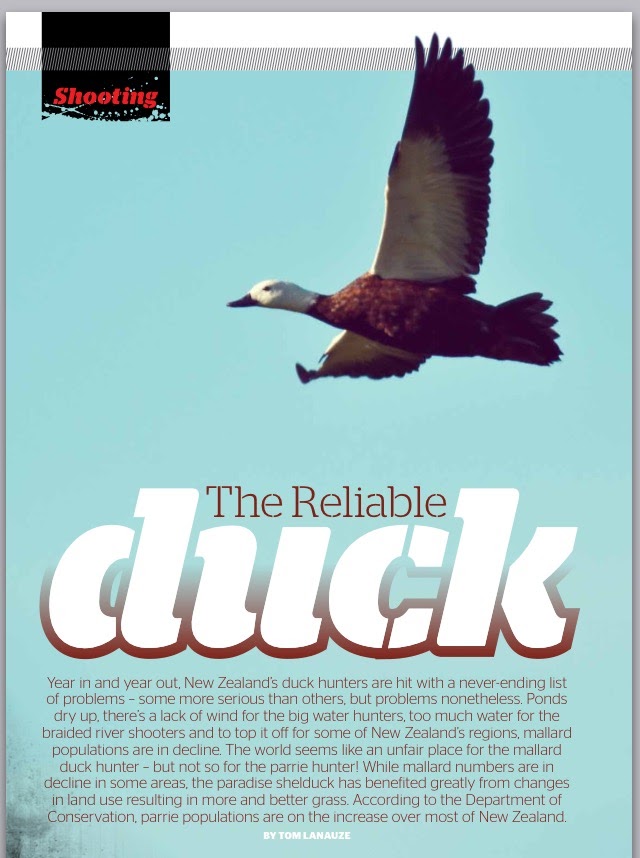
The Reliable Duck - the Paradise Shelduck

Coming from New Zealand, I have had a lot of requests for information on our Native Paradise Shelduck, and with their unique and beautiful colouring, they are often a prized trophy by International hunters. Here is an article I penned for NZ Rod and Rifle Magazine, that should offer some insight to this wonderful bird, and how to hunt them in the amazing hunting paradise, that is New Zealand.

Please click HERE for the full article


"How to" hunt open water Mallard's

New Zealand is my home, but its also home to some of the best open water mallard shooting in the World. This is Lake Ellesmere (Te Waihoa), and it's where I learnt the art of Water fowling. It's beautiful on a sunny day....but hunts best in a cold Southerly, rain and hail!

Why do I love it so much?

Unlike other form of Duck hunting, you are not simply waiting for the birds to return home to a roost site, or to a feeding ground. You are hunting birds that have been literally blown off the water due to the weather. So what works for me?

  • I try to pick a location that's both visible to passing ducks, but sheltered. I find sheltered bays, or areas in behind sand bars and islands work best, but also flooded areas on the fringes of the downwind end of the water body can produce good shoots
  • Having the right equipment is also a huge plus. Hunting the fringes and flooded areas requires you to be mobile - a layout blind works best here.  
  • The right amount of decoys, is also needed, just to make your spread visible to the passing ducks, so motion decoys can also be a bonus - but don't rely on them as late season birds may flare off them. 
  • Don't set decoys too far downwind. These ducks are tired, and often they will drop down the first chance they get. I make sure all my decoys are within range when hunting big water for mallards.
  • Calling is still important, and a powerful call is best suited to cut through the wind, while something softer is best in finishing them into the decoys.
  • Concealement is a huge factor. On these dark days, your face and hands stick out from a long way out, make sure to cover up
  • Ammunition and choke selection is also critical. Remember that your pattern will be blown around in the wind, and you may have to take pass shots at bird that don't fully commit (if you want too). A mid-extended range choke, and a heavier than average cartridge are a help, and I've found 3 inch, 36gr #2 works best for me. 

You don't need all of these elements to bag a duck or two, but in my experience, they sure do help, and they work for me!

Lake Ellesmere - Its scenic in the sunshine, but if you ask me, it looks best covered in cloud and rain!